
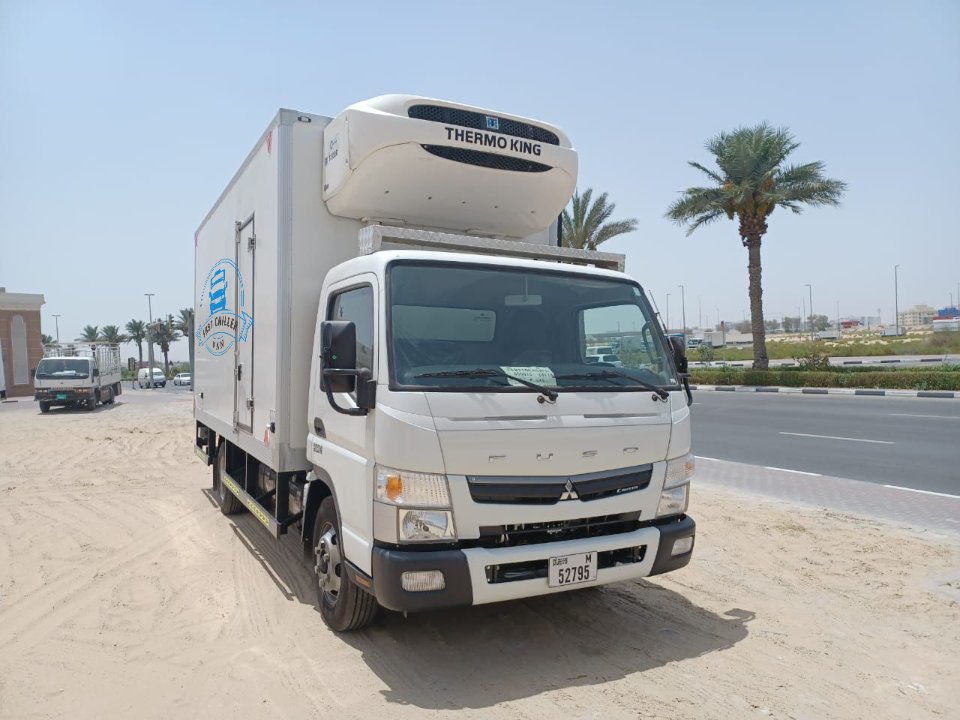
Most conversations about refrigerated transport in Abu Dhabi start with the cargo — what is being moved, what temperature it needs, how much of it there is. For half the year, that is the wrong starting point. From roughly May to September, the cargo is rarely the hardest part of the job. The heat is.
When ambient temperatures across the capital push past 45°C and touch 50°C on the worst afternoons, a refrigerated truck is no longer just “keeping things cold.” It is fighting a gap. A chilled load sits at 2–4°C. A frozen load sits at −18°C. The air outside the box is sitting forty-six to nearly seventy degrees above that, for hours at a stretch, on a highway with no shade. Everything that goes wrong with cold transport in an Abu Dhabi summer traces back to that gap and how the operation is built to manage it.
This is not about which truck to book. It is about what actually happens to a refrigerated vehicle once it leaves the yard in July — and why the operators who run clean cold chains here plan around the heat instead of reacting to it.
The real variable is the gap between outside and inside
A refrigeration unit is rated to do a certain amount of work. In a temperate climate, holding a box at 2°C is a relatively light task because the outside air might be 20–25°C. The unit cycles on and off, sheds heat easily through its condenser, and spends a lot of the day idle.
Abu Dhabi removes that breathing room. The hotter the outside air gets, the harder it is for the condenser to reject heat into it — the unit is trying to dump heat into air that is already close to its own limit. So the same vehicle that holds temperature comfortably in February runs far closer to continuous operation in July, with much less margin if anything goes slightly wrong.
There is a regional detail that compounds this and rarely gets mentioned: dust. Fine sand works its way into condenser fins and coats them over time. A partially clogged condenser sheds heat poorly, and in 48°C air that is the difference between a unit that holds and a unit that slowly loses ground on a long run. In this climate, condenser cleaning is not maintenance housekeeping — it is part of keeping the cold chain intact through the summer.
Pre-cooling is not optional here
A refrigeration unit is built to hold a cold load, not to chill a warm one down quickly. That distinction gets ignored constantly, and it causes more summer failures than equipment faults do.
If a truck box has been sitting closed in the sun and the interior has soaked up heat, then product is loaded into that hot box, the unit now has two jobs at once: pull the box down and hold the cargo. In mild weather it might recover. In peak Abu Dhabi heat it often cannot get ahead, and the load rides warmer than the gauge suggests for the first part of the trip — which is exactly when temperature-sensitive cargo can least afford it.
The fix is discipline, not equipment. Pull the box down to temperature before loading. Keep doors shut during staging. Load fast. None of this is complicated, but in summer the cost of skipping it is real, and the operators who treat pre-cooling as a fixed step rather than an optional one are the ones whose loads arrive where the paperwork says they should.
Every door opening costs more in summer
On a single-drop run, door discipline barely matters. On a multi-stop run across Mussafah, ICAD and the surrounding distribution points, it becomes one of the main things separating a clean delivery from a marginal one.
Each time the doors open, hot outside air floods the box. The unit then has to claw the temperature back down — and in summer that recovery takes longer than most people expect. Now stack ten or twelve stops across a morning. If the box never fully recovers between openings, the temperature inside drifts upward stop by stop, and the last few drops on the route ride warmer than the first ones did.
This is why route sequencing in summer is partly a thermal decision, not just a traffic one. The most heat-sensitive cargo wants to come off the truck early, while the box is still firmly at temperature, rather than being the load that has absorbed every door opening on the route.
Duty cycle, strain, and the cost of a mid-route failure
A unit running near-continuously through a summer day is under far more strain than the same unit in winter. That changes what pre-trip checks are actually for. A worn door gasket that leaks a little warm air is a minor nuisance in February and a steady drain in July. A slightly low refrigerant charge that goes unnoticed in mild weather shows up as a unit that cannot hold on a long afternoon run. Condenser cleanliness, seal condition, defrost behaviour, charge level — in this climate these stop being box-ticking items and become the things that decide whether a load survives the route.
The other half of the cost is location. A refrigeration fault on a city loop is recoverable. A fault on a long run, in peak heat, with a full frozen load and no nearby backup, is a different problem entirely — the load is exposed the whole time a solution is being arranged, and at 48°C ambient that exposure adds up quickly. The strongest argument for well-maintained equipment in Abu Dhabi is not efficiency. It is that the margin for a mid-route failure shrinks dramatically once the heat is on.
Distance and timing turn heat into the dominant factor
Inside the city the heat is manageable because runs are short and the unit gets relief between stops. The picture changes on the longer corridors. A run along the Al Ain corridor, or out toward the Western Region energy sites that sit 150–200 km from the nearest supply base, means the unit has to hold temperature continuously for hours at peak ambient, with no city-break in between. That is the hardest single thing a refrigeration unit does all year, and it is where equipment condition and a properly pre-cooled load matter most.
Timing is the lever operators actually control. Dispatching early to get the heaviest legs done before the afternoon peak is not a small optimisation — across a summer it is one of the biggest factors in keeping loads stable. Traffic plays into this too. A truck crawling in slow traffic or idling for long stretches gets less airflow across the condenser right when the air is hottest, so the unit cools least efficiently exactly when it is being asked to work hardest. Routing and departure time, planned around the heat curve, do more for cold-chain stability in an Abu Dhabi summer than almost anything that happens at the vehicle level.
Where heat actually breaks the cold chain
It is rarely the refrigeration unit by itself. The failures show up in the gaps around it: a box left closed in the sun before loading, so it starts the day already warm. A container cleared at Khalifa Port that waits too long in an exposed yard before a truck collects it, soaking up heat the whole time. A loading bay where doors stay open longer than they should during a slow unload. A vehicle parked in full sun between drops instead of shade. None of these are equipment problems. All of them are heat exposure that a tighter operation would have removed — and all of them are within a planner’s control if the heat is treated as the first constraint rather than an afterthought.
That is the underlying point. In Abu Dhabi, arranging temperature-controlled transport is, for a large part of the year, a heat-management decision before it is a vehicle decision. The cargo defines what temperature you need. The climate defines how hard it is to hold it, how much margin you have, and how little room there is for error on a long afternoon run. Operators who build their planning around that reality — pre-cooling, door discipline, route timing, maintained equipment — are the ones whose summer cold chains hold. The ones who treat a refrigerated truck as a box that simply “stays cold” are the ones who find out, usually on the hottest day of the route, that it does not work that way here.
For businesses weighing how to set up temperature-controlled movement across the capital’s routes and industrial zones, the practical groundwork is matching equipment and route planning to these conditions before committing — the range of refrigerated truck options across Abu Dhabi’s routes is a sensible place to start that planning, alongside an honest look at how different sectors in the emirate approach cold transport differently.