
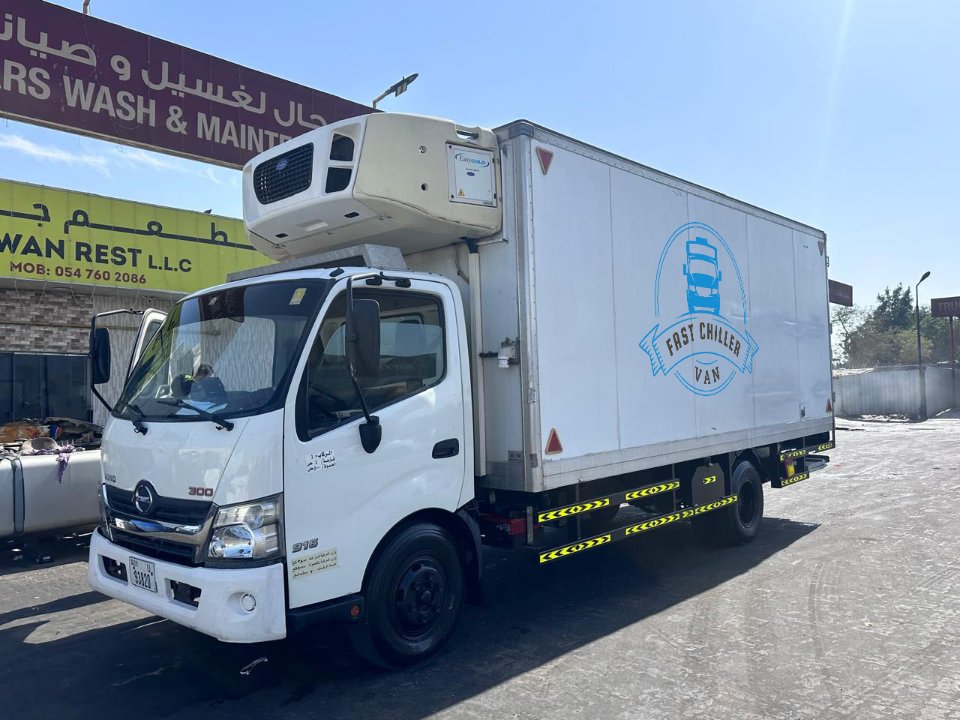
The question business owners usually ask us is whether a chiller truck is “better” than a van. That’s the wrong question. A truck isn’t better or worse than a van — it’s the right tool past a certain point and the wrong one before it. The real skill is knowing where that point sits for your own operation, because getting it wrong costs money in both directions. Switch too late and you’re running extra van trips or losing loads to heat. Switch too early and you’re paying for capacity that rides around half empty.
This guide is about finding that line. Not a list of truck features, but the actual signals — load size, cargo shape, distance, and temperature — that tell you a chiller van has stopped being enough and a chiller truck has become the sensible choice.
The capacity tipping point
A chiller van comfortably handles roughly one to one-and-a-half tons. That covers a lot of daily city work. The problem starts when your regular load creeps past what a single van can carry, because the fix most businesses reach for is a second run.
Two runs instead of one sounds harmless until you add it up: double the driver hours, double the fuel, double the door openings, and twice the window for something to drift warm on the way. Once you’re consistently splitting a day’s delivery across multiple van trips, a single chiller truck — available from 3 up to 10 tons — moves the same load in one trip, at a lower cost per delivered ton and with far less handling. As a rough rule, when one delivery regularly needs more than one van, or sits north of two to three tons, the truck stops being the expensive option and becomes the cheaper one.
When the shape of the cargo decides for you
Weight isn’t the only trigger. Sometimes it’s how the goods are packed.
Pallets are the clearest example. Vans aren’t built for standard pallets, so you end up hand-loading loose cartons — slow, awkward, and it stacks unevenly. A chiller truck with proper floor space and a tail lift takes pallets straight in and out. If your goods arrive palletized, that alone often settles the decision before weight even comes into it.
Airflow is the other one, and it’s less obvious. In a van packed wall to wall, cold air can’t circulate around a dense load, so the middle of the stack rides warmer than the edges — the cargo looks fine on the gauge at the door but isn’t uniformly cold inside. A truck has the height and the room for air to move around a bulk load, which means more even cooling across the whole shipment, not just around the outside. So moving up isn’t only about fitting more in. It’s about the load actually holding temperature all the way through.
When distance changes the math
A van running repeat long-distance legs is an expensive way to move bulk. If you’re regularly sending cargo across the emirates — Dubai to Abu Dhabi, out to Al Ain — a van forces you into multiple trips, each one holding temperature for hours on the road. One truck run replaces three van runs on cost, on driver time, and on the number of times the load is exposed to the outside heat during loading and unloading. For bulk moving over distance, consolidating into a single truck is almost always the steadier and cheaper call.
When a van is still the right call
This cuts both ways, and it’s worth being honest about, because jumping to a truck too early wastes money just as surely as jumping too late loses cargo.
If your loads are genuinely small and your route is tight multi-drop across busy parts of the city — Deira, Bur Dubai, dense commercial streets — a van still wins. It parks where a truck can’t, moves quicker between close stops, and costs less to run all day. A well-matched chiller van on a dense city route routinely outperforms a truck that can’t physically reach half the drops. Capacity you don’t need is just cost you’re carrying for no reason. The truck earns its place when volume, pallets, or distance genuinely demand it — not before.
If it has to stay frozen, this is a different question
One thing changes the whole conversation: temperature class. Everything above assumes chilled cargo, held at +2°C to +5°C. If your goods have to stay frozen — ice cream, frozen meat, seafood, certain pharma — a chiller truck won’t do it, no matter the size. Frozen means −18°C or below, which is a freezer truck, a different vehicle built for deep-freeze work. So decide the temperature class first, then worry about the size. Getting those two steps in the wrong order is how the wrong vehicle gets booked.
A quick way to make the call
Before you book, five questions usually settle it:
- Is a single delivery regularly more than one van can carry? If yes, move to a truck.
- Is the cargo palletized? Pallets and tail-lift loading point to a truck.
- Are you running the same route several times to clear one day’s load? That’s a truck job done in one trip.
- Are your loads small and your drops tight across the city? A van still wins — don’t over-buy capacity.
- Does it need to stay frozen, not just cold? Then it’s a freezer truck, not a chiller anything.
Get the temperature class right first, then match the size to your real load and route. Do that, and you avoid both traps — the spoilage and extra trips that come from switching too late, and the wasted spend that comes from switching too early.